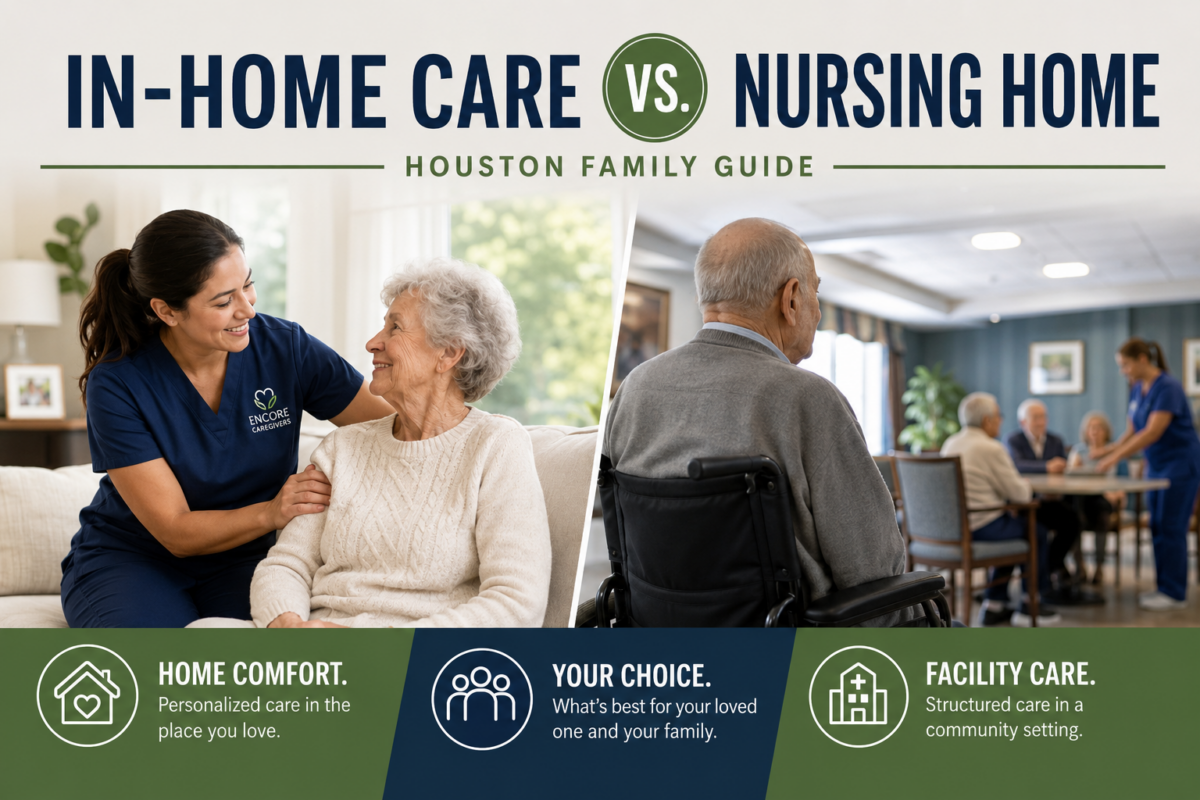
Most families don’t plan for this conversation. Something changes — a fall, a bad week, a call from a neighbor — and suddenly care can’t wait. If you’re working through that right now, you’re in the right place. Our in-home care services are built for families at exactly this point, and we want you to have the full picture before you make any decisions.
Key Takeaways
- Houston in-home care runs $28–$35/hour or can be more. For families not yet at the 24-hour threshold, that’s usually cheaper than a nursing home.
- Nursing homes have medical staff on site around the clock — in-home care keeps your loved one in their own home, with caregivers focused entirely on them.
- Seniors in Memorial, River Oaks, Tanglewood, West University — they’ve built routines over decades. In-home care doesn’t disrupt that.
- Encore Caregivers’ caregivers are supervised by an RN. That closes the clinical gap most families lose sleep over.
- What’s right depends on your loved one’s actual medical picture, care needs, and desires.

What In-Home Care Actually Looks Like
A caregiver comes to your loved one. Not the other way around.
No move. No adjustment period in a shared room. No leaving behind the dog or the chair they’ve sat in every morning since 1987. Personal care, companion care, meal prep, light housekeeping, medication reminders, and transportation to appointments. For families dealing with dementia, ALS, cancer, or post-surgery recovery, that specialized support is there too.
At Encore Caregivers, every caregiver is trained and personally supervised by an RN. That’s not standard in this industry. Most agencies don’t have clinical oversight built into the care model. We do. And Houston families notice.
What a Nursing Home Provides
Round-the-clock medical care in a residential facility. Continuous nursing supervision, complex wound care, IV therapy, rehabilitation services — the level of clinical management that genuinely can’t be replicated at home for some patients. If you’re weighing whether 24-hour home care might better meet your parent’s needs, that’s worth exploring first.
There are about 61 nursing homes in the Houston area. Quality varies widely. Cost can average $8,000–$12,000 per month for a private room, with some facilities running considerably higher.
A nursing home is the right answer when a parent’s medical needs exceed what home care can safely provide. Not before that point.
The Real Differences, Side by Side
| In-Home Care | Nursing Home | |
|---|---|---|
| Setting | Parent’s own home | Residential facility |
| Staffing ratio | One-on-one | Shared among multiple residents |
| Medical supervision | RN-supervised (Encore Caregivers model) | 24/7 nursing on site |
| Monthly cost (Houston) | Depending on hours — $28–$35 per hour | $8,000+ |
| Flexibility | Adjust hours as needs change | Structured facility schedule |
| Familiarity | Stays in their home and neighborhood | Full relocation required |
| Family involvement | Natural, easy | Visiting hours, shared staff attention |
| Best for | Chronic conditions, dementia, recovery, aging in place, companionship | Complex medical needs requiring daily clinical intervention |
Why Neighborhood Matters Here
Houston isn’t one thing. And the families we serve aren’t a single thing, either.
In Memorial and Tanglewood, seniors often live in larger homes they’ve owned since the 1970s. The yard, the neighbors, the drive to their church on Sunday — these aren’t small details. They’re the structure of a life. Moving to a facility doesn’t just change where someone sleeps.
River Oaks families tend to want personalized, discreet care. Not a shared room and a rotating nursing staff. In-home care fits that naturally.
In West University and Bellaire, multigenerational households are common. An adult child is often nearby — sometimes in the same home. In-home care slots into that family structure in a way a facility can’t match.
Along the Galleria corridor, seniors in high-rises often have active social lives they’re not ready to give up. A caregiver who comes to them, helps them get ready, accompanies them, handles what they can’t — that keeps a life intact longer. Not forever. But longer.
None of these families are in denial about their parents’ needs. They’ve made a considered choice about where those needs can best be met. If you want to go deeper on why home beats a facility for most seniors, we covered it here: the unique advantages of home care.
Cost Comparison: Home Care vs. Nursing Home
This is where families usually start. And it’s also where many get surprised.
People assume nursing homes cost less because everything is bundled together. They usually don’t.
According to Genworth’s Cost of Care Survey, Houston-area nursing homes average roughly $8,000–$12,000 per month for a private room. Some exceed that depending on the facility and level of medical care required.
In-home care works differently. You’re paying only for the hours you actually need.
For someone needing four hours each weekday, the monthly cost may be less than half the price of a nursing home. Even eight-hour daily coverage can remain less expensive than residential care. Twenty-four-hour care changes the math—but by that point, many families are comparing it against skilled nursing anyway.
The question isn’t simply “Which costs less?”
It’s “How much care does your loved one actually need today?”
Buying more care than necessary is just as wasteful as buying too little.
When In-Home Care Makes More Sense
In-home care is usually the better fit when:
- Your parent is still mentally engaged but physically slowing down.
- They’re recovering from surgery or hospitalization.
- They’ve been diagnosed with Alzheimer’s or another form of dementia but remain safe at home with supervision.
- They simply need help with bathing, dressing, meals, medication reminders, or transportation.
- Remaining in familiar surroundings improves their quality of life.
Many families also combine respite care with ongoing support to avoid caregiver burnout. If you’re caring for a loved one yourself, learn more about respite care services and how temporary relief can help you continue providing care long term.
For most seniors, home isn’t just where they live.
It’s where they know where the coffee cups are.
It’s where the family photographs are.
It’s where they still feel like themselves.
That matters more than people realize.
When a Nursing Home Is the Better Choice
Sometimes home isn’t enough.
Families don’t fail when they choose a nursing home. They make the best decision available given the medical situation.
A nursing home is usually appropriate when:
- Daily skilled nursing care is required.
- Complex wound care or IV medications must be administered.
- The patient requires frequent physician oversight.
- Safety can no longer be maintained even with full-time caregivers.
- Specialized rehabilitation services are needed every day.
Those situations absolutely exist.
The key is making sure you’re choosing a nursing home because your loved one truly needs skilled nursing—not because you didn’t know another option existed.
Questions Families Should Ask Before Deciding
Before making any decision, ask yourself:
- Can Mom safely stay home with help?
- How many hours of care does she actually need?
- Would familiar surroundings improve her quality of life?
- Does she need skilled nursing—or simply assistance with daily living?
- What does she want?
That last question gets overlooked surprisingly often.
When seniors are capable of participating in the decision, they should.
It’s their home.
It’s their life.
The care plan should reflect both.
Why Houston Families Choose Encore Caregivers
Every home care agency says they’re compassionate.
Here’s what actually makes Encore different.
- RN-supervised caregivers
- Locally owned and operated since 2009
- Care plans customized around each family—not standardized templates
- Caregivers carefully matched to each client’s personality and care needs
- Flexible scheduling from a few hours a week to 24-hour home care
- Serving families throughout Memorial, River Oaks, Tanglewood, West University, Bellaire, the Galleria area, and greater Houston
Families don’t call us because they want “home care.”
They call because they want their parent to stay home safely for as long as possible.
That’s what we help make possible.
Frequently Asked Questions
Is home care cheaper than a nursing home?
Usually, yes—especially when your loved one doesn’t require around-the-clock skilled nursing care. Home care allows families to purchase only the hours they actually need, while nursing homes charge a monthly residential rate regardless of how much assistance is required.
Can someone with dementia stay at home?
Often, yes. Many seniors living with Alzheimer’s disease or other forms of dementia can remain safely at home with properly trained caregivers. Learn more about Encore Caregivers’ dementia care services.
Does Medicare pay for home care?
Medicare generally does not cover ongoing non-medical personal care. Some short-term skilled home health services may qualify under specific circumstances. Our team can help explain what options may be available.
How quickly can care begin?
In many situations, care can begin within 24 to 48 hours following the initial consultation, depending on caregiver availability and the client’s needs.
Can I start with only a few hours?
Absolutely. Many families begin with just a few hours each week and increase care as needs change.
Talk With a Houston Home Care Specialist
Every family’s situation is different.
If you’re trying to decide between in-home care and a nursing home, we’ll help you understand your options—without pressure.
We’ll answer your questions, explain how care works, and help you determine whether home care is the right fit for your loved one.
Encore Caregivers
Serving Houston, Memorial, River Oaks, Tanglewood, West University, Bellaire, The Galleria, and surrounding communities.
“`