
The missed pills. Mail stacking up on the counter. That half-second pause before she takes the stairs. You’ve seen it, and now you’re stuck on the question no adult child wants: does Mom stay home with help, or is it time for assisted living? You’re not alone in the stall. Most Houston families land here first, pulled between two decent options and terrified of picking the wrong one. So this walks through what actually separates them — money, care, independence, safety. If home is still on the table, our home care services and respite care options were built for this exact fork in the road.
Key Takeaways
- In-home care sends a caregiver to your parent’s house. Assisted living sends your parent to a facility.
- Part-time help? Home usually costs less. It’s only heavy, all-day care where a facility’s flat rate starts to compete.
- Staying home protects the routines, the neighbors, the whole life your parent already built.
- There’s no winner here. It comes down to hours needed, what your parent wants, whether the house is safe, and what you can afford.
- A lot of families ease in with home care and add hours later. Try locking in that kind of flexibility at a facility.
What In-Home Care Actually Means
A trained caregiver comes to your parent. In the house she already knows by heart. Nobody moves. The bed by the window stays right where it is.
They handle the stuff that quietly gets harder every year. Bathing. Meals. Medication reminders, a little housekeeping, a ride to the cardiologist. Maybe your family needs four hours on Tuesdays. Maybe someone is there all night. It bends to the person, not the other way around.
At Encore, it’s non-medical care, and an RN runs it. That’s not a small detail. A registered nurse writes the care plan and keeps watching it, so you’re not handed a helper and left guessing — there’s a clinical mind on the case. That backbone shows up in every single client we take.
What Assisted Living Actually Means
Think residential community. Your parent gets a private apartment, meals in a shared dining room, and staff down the hall for daily help. Activities come baked in — bingo, bus trips, a stretch class before lunch.
But make no mistake, it’s a move. New walls, new faces, a new schedule that isn’t hers. For a parent who’s been rattling around an empty house and aching for company? That can be a real gift. For one who loves her street and her kitchen and her forty years of memories in that living room? It can hurt. Both of those are normal.
And assisted living isn’t a nursing home — people mix these up all the time. Nursing homes provide skilled medical care. Assisted living is for folks who are mostly independent and just need a hand with the day. Weighing the facility path in general? Our home care vs. nursing home breakdown covers that corner.
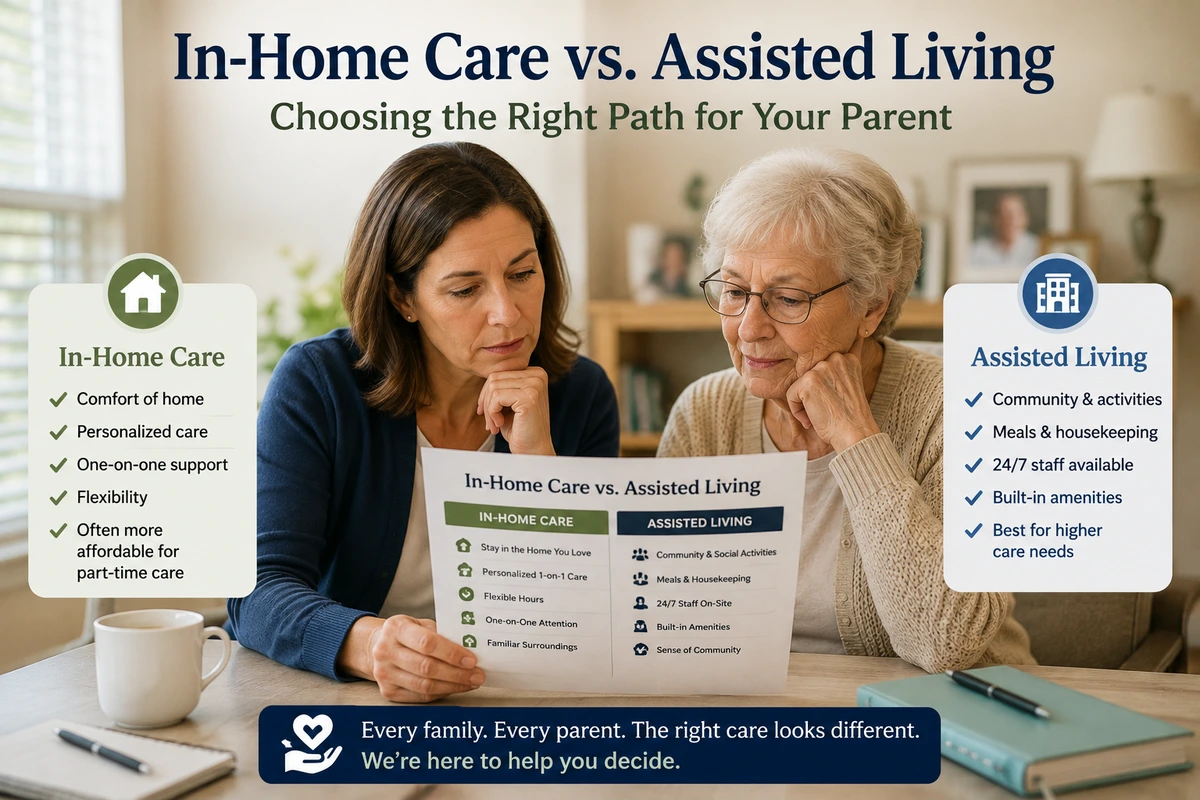
In-Home Care vs. Assisted Living: Side-by-Side
| Factor | In-Home Care | Assisted Living |
|---|---|---|
| Where your parent lives | Their own home | A residential facility |
| How you pay | By the hour, for the help you actually use | Flat monthly rate, usually plus hourly care-level fees |
| Shines when… | Needs are part-time to moderate | Needs are constant and heavy |
| Independence | Stays high; life doesn’t change address | Drops; it’s a communal setting and schedule |
| Attention | One caregiver, one parent | Staff split across many residents |
| Social life | Rides on family and companion visits | Neighbors and activities are already there |
| Flexibility | Dial hours up or down anytime | Locked once the move happens |
| Moving required? | No | Yes |
The Cost Question, Honestly
Families want a straight number here. Can’t give you one, but I can give you the real logic…
Families want a straight number here. Can’t give you one, but I can give you the real logic. Home care is billed hourly. So if your parent needs 20 or 30 hours a week, home is very often the cheaper road — and every dollar lands on your parent, nobody else.
Assisted living runs on a flat monthly rate. Looks tidy on the brochure. Then the care-level add-ons creep in as needs grow. Where does the math flip? Somewhere up near round-the-clock care, a facility’s flat rate can actually beat piling on hourly hours.
So nobody’s just “cheaper.” It hinges on hours. Fewer hours, lean home. All-day, hands-on needs can lean facility. We’ve got a Houston cost guide coming that covers local numbers, and Medicare’s own long-term care coverage page is worth a read for what public programs actually pay for. Which, spoiler, is less than most people hope.
Questions to Ask Before You Choose
Sit with these first. No rushing.
- Be honest — how many hours of help does she need a day? Not the number that makes you feel better.
- Does your parent actually want to stay home, and how hard would she fight to?
- The house. Safe as-is, or safe after a grab bar and a few fixes?
- Is home keeping her connected, or slowly boxing her in alone?
- Can you carry this cost for years? Months are easy. Years are the test.
Your answers do the pointing. Wants to stay put, needs part-time help, safe house — that’s an in-home care family, plain as day. Isolated, needs a lot every day, open to moving? Assisted living might be where she blooms.
When Families Choose In-Home Care
Home. That’s what most Houston families we meet quietly hope for, and it’s usually what their parents want, too. There’s sense in it. Familiar rooms calm the nerves, and that goes double for someone with early memory changes — the Alzheimer’s Association points to routine and familiar surroundings as a way to ease confusion, which is the whole spine of our dementia care approach. Keep the routine. Keep the space.
Home care also moves with you. Mornings to start. Afternoons when mornings stop being enough. And if the day comes, 24-hour home care without packing a single box. Family caregiver running on empty? Respite care steps in, and nobody gets uprooted. People shrug off that adaptability right up until it’s the thing saving them.
Frequently Asked Questions
1. Is in-home care cheaper than assisted living?
Usually — if the help is part-time to moderate. You pay by the hour, so nothing’s wasted. The facility’s flat rate only pulls ahead way up at round-the-clock care.
2. Can my parent really get the same care at home?
For non-medical needs, pretty much all of it. Bathing, meals, med reminders, getting around, company. And with Encore, an RN oversees the plan, so it’s not care flying blind.
3. What happens when her needs grow?
You add hours. Simple as that, right up to overnight and 24-hour support. No move, no new address to learn — which is exactly where facilities can’t follow.
4. Isn’t assisted living just a nicer nursing home?
No, and it’s a common mix-up. Assisted living is for mostly independent seniors who need a little daily help. Nursing homes handle serious, skilled medical care.
5. Which is better for dementia?
Depends on the stage. Early on, home and its familiar rooms tend to cut the confusion and the anxiety. Later stages can call for more structure. Plenty of families do in-home dementia care and adjust as it progresses.
6. Won’t she get lonely at home?
She might not. A caregiver is genuine company, one-on-one, plus whatever visits and outings the family adds. But if crushing isolation is the real problem, say so out loud — that changes the calculus.
7. How many hours do families usually start with?
All over the map. Some begin with a handful of hours a couple of days a week. Others need daily help from the first morning. A care assessment tells you the honest number.
8. Does Medicare cover any of this?
Mostly no — Medicare skips long-term non-medical care in both settings. Long-term care insurance or Medicaid might chip in. Pull up your parents’ actual policy and check.
9. Can we just try home first and see?
Yes. And it’s the smart play. Start small, watch how it goes, reassess. You haven’t committed to a move you can’t take back.
10. How do I even bring this up without a blowup?
Talk independence, not decline. Frame the help as the thing that keeps her home — not the flashing sign that home’s ending. How you say it beats what you say.
11. Are Encore’s Houston caregivers background-checked?
Screened, trained, RN-supervised. Yes. And ask that of any agency before you sign a thing — if they dodge it, walk.
Making the Call
Nobody’s got a one-size answer here. Just the one that’s right for your parent and your family. Independence, her own four walls, cost you can flex? Home care tends to fit. Isolated, needs constant support, willing to move? Give assisted living a real look — don’t rule it out on guilt alone.
Want a hand sorting it? That’s the job. Encore Caregivers has walked Houston families through this since 2009, RN-supervised the whole way. Find us through the home care services page or call 713-686-2233. Even if all you need is a gut check.